Rhythm and Tension (and other notes...)

being more about tensions like this then about it making traditional dramaturgical sense (Nadia)

staying completely weird

not becoming super rational.  but rather square rooting 'normal', rationalist ideas and senses.

a Dialogue all the while in general (but not neccesarily in language)

allowing multiple spaces to exist. afs is thinking of how narrative can work with slippages and indications that reveal that what you just heard/saw...  happened in the past...

working with transitions

very much about our process

always lived in the future
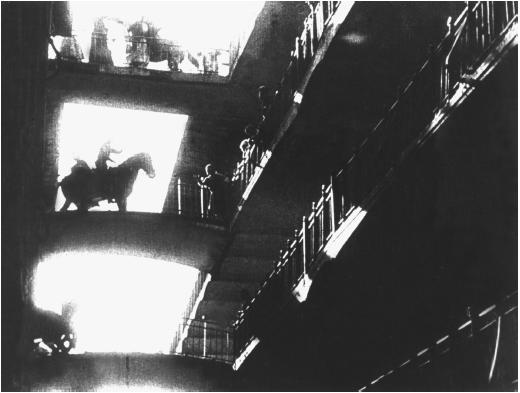


always live in the present (!)


....she will come on the stage (then will come on the stage slightly different)


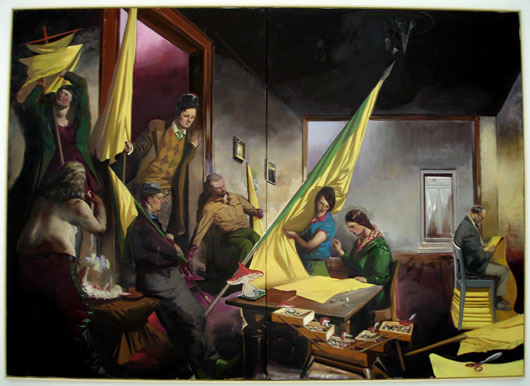
how about:? person in blue outfit who is not-there, with the words in dark blue "Trotsky 00" on his back (but also sorta blended in to his outfit, so that only in certain light can you read it) a... occassionally arrives... does some things (like starts sewing this gigantic beautiful yellow flag that is draping suddenly across the stage)... dissappears...



how about you have this great cosmonaut helmet from time to time when we really get into the future... or maybe just a cool contemporary motorcyle helmet and this image comes on that you stand in front of and sorta move about with this strange cool, aggressive energy for a while (in the helmet)... 


i love the idea of an enormous amount of media that is tracking us. that is, all this worldwide recording. waiting and listening to ever word! what is going to happen!? what is going to be said!? with all kinds of logos! and different colors! like hundreds of mics and cables.. all different colors and logos... 


*********


references (see new links in link section): Joseph Chaikin, Darren O'Donnel's main text "Social Acupuncture"  (canadian performance maker who made a monologue which featured this interesting back and forth in time thing)

sleeping with the devil/reza abdoh


a shot from a short movie of this iranian director

these two people are fighting with each other in spanish. i do not understand a word, but i found exactly this interesting. i could fight with you in georgian language and you could try to calm me down :)

actually the whole movie is great and gives me inspiration in terms of what kind of action we could do on stage. i like the way it is cut. just the moments.

here is the movie
sleeping with the devil

immigrant issue again :)


nazi eugenics exhibition

Background: Volk und Rasse was a monthly published by the J.F. Lehmanns Verlag, a leading racist publishing house that easily fit into the Nazi system. It published some anti-Semitic material, but focused more on the “positive” side of Nazi racial theory, the strengthening of the German racial stock. On this page, I include illustrations from the August 1936 issue that show posters displayed at Nazi exhibitions on race. Many such exhibitions were held throughout the country in the 1930’s. The unpleasant drawings of those with “defective” genes are particularly interesting. The goal was to build support for Nazi eugenics measures, sterilization of the “unfit,” etc.

The source: Volk und Rasse, August 1936.
Posters from Nazi Racial Exhibitions
Exhibition Entrance


German Propaganda Archive Calvin College


This is the entrance to a 1934 exhibition in Berlin titled “The Miracle of Life.”

Healthy Farming Stock


The title: “The life force of a healthy farming family.” To the left is a farming couple who married in 1734, and now have offspring carrying their blood in 175 farms. To the right, the caption says: “Two children per family would lead to death and decline.” The bottom right illustration shows deserted farms, were that to happen.

Birth Rates in Big Cities


This poster states that the decline in births is greatest in big cities, where one child is the norm.

Bad Blood


This poster shows what happens if parents of good racial stock have two children, but those of poor racial stock have four. They begin in equal numbers, but after 120 years the weaker are the overwhelming majority.

Sterilization


The title: “Sterilization is liberation, not a punishment.” It show three handicapped children, with the caption: “Who would want to be responsible for this?”

Effects of Alcoholism


The title: “The terrible results of a woman drunkard.” It shows that over 83 years, she had 894 descendents, of whom 40 were indigent, 67 criminals, 7 murderers, 181 prostitutes, and 142 beggars. “436 (about 50%) were asocial, and caused 5 million Marks of harm.”

Burdens of Genetic Illness


This poster asserts that someone with a genetic illness costs the state on average 50,000 Marks by the time he reaches 60 years of age, which must be paid for by healthy citizens.


Effects of Intermarriage


This poster shows what happens when relatives carrying a genetic illness intermarry. It claims: “Between 1876 and 1935, only 40 of the 947 marriage partners in this religiously-based community came from another place.” It shows that most such intermarriages produced children with genetic illnesses.


Bad Genes


Caption: “Bad genes enter a village.” This poster shows that a woman moves to a village and has an illegitimate child with an unknown father. In the second generation, the daughter has an illegitimate child. In the third generation, the child marries a relative. In the fourth generation, one descendent marries a drunkard, and they have five children, two of them deaf. Another mentally ill descendent has an illegitimate child who ends up in prison.

wilders as robin hood

i don't understand everything, but there is a women that answers the question 'who is wilders for her'- she says he is a robin hood of today, he speaks simple peoples language and he is not afraid to say his opinion.

'how aggression becomes a positive message'- lack of reasoning. use of simple people, like you and me- populist politics are build on this kind of ground.

here another fear propaganda


dear wilders can become our performer

is it an aggression or just stupidity?

the audience

may be the audiecne should not seat in the public, but be on stage with us, in our chaos of ideas and networks, may be they have to support the system running, like a labor.
boris groys suggested in his lecture that the system will collapse if we will not support it anymore. so may be the whole performance should be the metaphor of this saying. if we install some weird mechanisms that are connected to each other and the audience have to pull it or push it, make it work. even with the water, like if we offer them a glas of water- there could be the water system running made very simple and cheap. so that everything is connected to everything in a weird crazy way.
it would be great if the audience could in certain moment control the system, but if they will not comunicate this to each other -the control will be chaotic and neurotic, so the water might come form somewhere else where you don't know from where. or anything else can drop from the ceiling , or some fluid or paint will come out if somebody will touch the sensor, or the wind will blow. kind of effects. may be we can structure the audience with the rules. some of the can control the lights of the performance, some of them the sound, some of the the video. they can stop it or let it continue. and the scenes will be constructed out of videos, photos texts or our actions, like Foucault text or take it easy scene, or we can make some weird dance scenes as well, and read texts or tell personal stories.

may be creating such a system will allow us to put everything in what we want, no matter about the order of it, as we also do not have the order, everything is horizontal equally important. but we can think about the concrete strategies of control. may be we can think of some provocations. and give the audience the tools to not agree on something. to create a conflict.

to be continued.....

time is money, money is time

I thought about it as response again to your link with the issues of money and stock markets. the madness of it. we need them they need us. have been watching last days the matrix again with the eyes of our project. the machines need humans, and humans need the machine. i would replace the machine with system, market system.

i still can not summarize where we are, it is kind of chaotic but interesting net of ideas. and the net, comes also often in our talks back. so may be this should be our main focus- to create a network of ideas around aggression. the network is the system, it needs us and we need it. and may be this network can be extended to the audience, like they will be part of it. we need them for the performance, they need us ???
so can the audience be involved in our 'game'. you managed very well to make audience 'hot' with your rulet thing. may be we can think a bit in that direction. may be the audience can pull curtain buttons from the network we will build and by that decide the dramaturgy of the scenes. so we create scenes and topics and the line can be chosen by the public. but i want to think further about strategies to involve them into our network. may be they can contribute stories on spot. like there will be a bank of stories, as one of the options of the scenes.

to be continued


TIME IS MONEY

TAKE IT EASY

MONEY IS TIME

YOU ARE SEXY

TRUST YOURSELF

WE NEED YOU

YOU NEED US

THANKS FOR COMING

greetings from New-York

i found this text on adcompany&co site and i thought it is interesting for our project.

27.02.2012 Brief aus New York von Noah Fischer (Occupy Museums) an das Team vom (kommenden) Aufstand - Botschaft an die Niederlande


I guess it's possible that you guys first discovered capitalism in a golden tulip, but we Americans really developed it. Our industries invented products that everyone didn’t know they needed; a booming consumer culture built into Europe’s foundations after the war. But this still wasn’t enough. Our bankers began making money from money itself: packaging debt and betting against these deals. And when this wasn’t enough, we went to war with ancient civilizations, destroying them just to rebuild them into shopping malls for huge profits, but that was also still not enough. So finally, our wealthiest elites began to actually eat the American public. In the US we are experiencing a viral attack on everything that should be commonly owned, or not owned at all: our security, care in old age, education, natural resources, democratic government, our very culture. As we lose these things, our society is becoming un-glued, we are turning against each other like wolves. Unfortunately, we have exported this virus back to you, where it first originated. Here in New York, my Dutch friends, we may be living in your future. I’m writing to tell you that things have gotten really ugly on this side of the Atlantic, and we need your help before its too late.

Despite a perception by New Yorkers that we are at the center of the cultural universe, times have been tough for artists here. The glamorous art markets have not saved us, in fact they have enslaved us by our desires, making us so “hungry” that we’re willing to bite each others faces off for opportunities to enter this market which in reality only has a few winners and lots of losers. We had forgotten that as culture workers, we have a constant responsibility to stay vigilant against those who want to position us as jesters in their royal courts. We had fallen asleep. We dreamt that “political art” meant an expression of our favorite politics for a stage, or on a canvas, to be bought and sold and speculated on by the winners of capitalism. Waking up, we realize that there is no such genre as political art. In our times, only the economic structures around things are political. By letting the commonwealth of our culture morph into a big pyramid shaped market, by participating in this market, we were actually supporting a nasty position while we slept.

On September 17th, we finally woke up, came together, and opened up a space for protest and dialog in Zucotti Park. At Occupy Wall Street, we shared democratic tools developed in Egypt, Spain, Greece, and Brazil that would aid in this new culture. Our aim was to re-discover a culture of the commons and it caught on all over the place. Now we are involved in a global movement.

As it turned out, many of us occupiers are also artists. And now we have expanded the zone of protest into the cultural realm. We have begun occupying museums because economic injustice is as pronounced in the culture sphere as it is in the housing market. Museums claim to serve the public. They contain the symbols and narratives and treasures that we are all taught to believe in. But they have been co-opted by the 1% who sit on their boards influencing culture on one hand while also sitting on the auction house boards and speculating for personal gain on the other. In this way, power in the arts is concentrated and corrupt and this deeply disempowers most artists. So we held general assemblies at the gate of the Museum of Modern Art and Lincoln Center. Soon we were joined by large crowds. We aim to re-direct art away from the luxury markets and toward the common struggle and vision of the 99%.

I hear troubling rumors across the Atlantic. There are accusations in Holland that artists are sucking up public wealth like subsidized babies. This kind of rhetoric is a red flag for US artists. We know that in reality the wealthiest receive structural corporate welfare and keep their expanding riches offshore and immune from politics. To deflect criticism, they make artists into punching bags, that’s what happened years ago in our “culture wars” of the early 1990’s. I fear that the artists of Europe—especially our friends the Dutch, who have so long enjoyed support from the state that we New Yorkers could only dream of, will lose their autonomy from these hungry markets. The virus that wants to eat away the bonds that holds our society together is now infecting you. If you lose this battle, it will be a major setback for all of us.

But this nightmare need not become our reality. Let’s wake up and fight together!

Let’s not separate our art from this struggle, but use our creativity in the service of it.

noahfischer.org

the madness

we were talking about-the madness that comes from insecurity, impossibility of knowing for sure, the fear of not being able to control something - this is the irrational part of the market. the precarity of the market, the impossibility of full control, on the other hand-the soviet state was an example of an absolute control that brought the same state of precarity. people didn't know when and how the state will punish them. and this state of fear brought them into the state of madness. can we say that violence produces madness? or madness is produced by the violence? or/and madness produces violence?


hysteria in my family was probably the possibility to locate the madness and name it a madness. this was a tool to keep a search for the truth. in Aristotle's sense to go through the cleansing. 'catharsis'. can we combine cantharsis and brechtian not didactic but rather alienating elements?